Excerpts
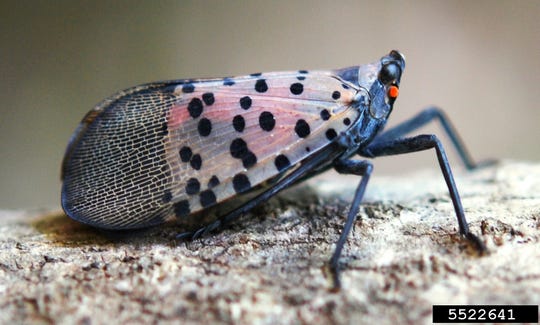
The exotic-looking bug is native to Asia, as is the
tree of heaven that hosts it. Adult insects are about 1 inch long,
and feature a black head, grayish black spotted forewings and reddish
black spotted hind wings, according to according to Rutgers' New Jersey
Agricultural Experiment Station. The first U.S. spotted lanternfly
sighting was in Berks County, Pennsylvania, in 2014.
It's
easy to inadvertently transport the bugs, which feast on a variety of
produce. They're plant hoppers — and also can hitch a ride on your
car. Because egg masses are laid on smooth surfaces and look like a
patch of mud, it's very likely that they could go unnoticed on outdoor
items, building materials and even bikes and scooters, according to NJ
officials.
"The spotted lanternfly is known to feed on 70
different types of trees, fruit, vegetables and grains. So far there has
been almost no impact on agriculture in New Jersey," the NJDA said in a
response to the Courier-Post.
Grapes and hops are
particularly vulnerable. The liquid emitted by the spotted lanternfly
allows the growth of sooty mold that makes the fruit unmarketable. The
grape harvest can be decreased by 75 to 90 percent, according to the
NJDA.
In Burlington County, where NJDA crews are working in Palmyra Cove,
another sighting was reported in Westampton, according to the county's
public information officer, Nicholas Gangemi.
State officials also are turning to the public to help spot the damaging insects.
Anyone
who thinks they see a spotted lanternfly or a spotted lanternfly egg
mass to destroy them first if possible, and then email SLF-plantindustry@ag.nj.gov or call 1-833-223-2840 (BADBUG0) to provide the exact location.
Entire article at




No comments:
Post a Comment